We are preparing to leave Lake Michigan. It is a beautiful lake, challenging for sure but in the end we found the boating somewhat boring overall. Dictated by the geology each cruise started with a run down a channel, exit through a breakwater, turn left, cruise for three to four hours, turn left, through another breakwater and tie up.
Two major rock types are found in Michigan. The ancient igneous and metamorphic rocks that compose the Precambrian, or Canadian Shield in the western part of the Upper Peninsula. The igneous rocks are hard, crystalline, resistant to erosion, and are largely made up of granites and metamorphic rocks.
The Lower Peninsula and the eastern parts of the Upper Peninsula are underlaid by a series of sedimentary rock layers: The Michigan Basin. These rock formations, consisting largely of shales, limestones, and sandstones, were deposited on the bottom of ancient seas that covered Michigan on and off for millions of years. The basin is estimated to be about 14,000 ft (4,267 m) thick, and its rocks rest on the top of a very old Precambrian surface. The various layers of sedimentary rock are piled up on top of one another like a series of saucers.
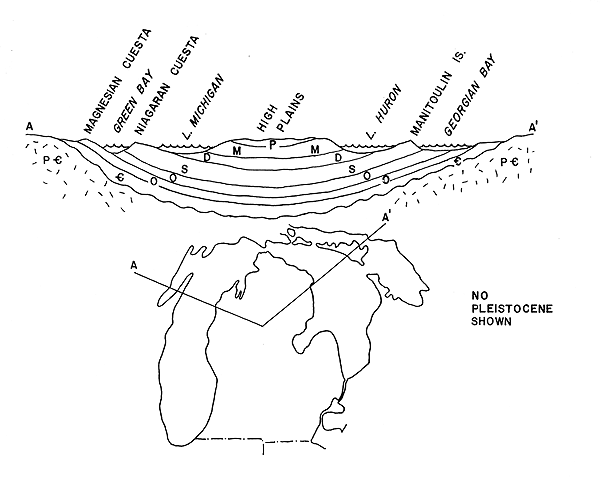
More important is the thick layer of glacial till deposited during the Pleistocene era. Outwash plains occupy extensive areas in northern Michigan and constitute the poorest soils. The sandy hardwood and jack pine plains of the northern half of the Lower Peninsula are typical. These have been problem lands of Michigan. Forty to 50 years ago large scale attempts were made to clear and farm these lands, but the thin forest humus overlying infertile sand was soon exhausted and thousands of hopeful pioneer farmers starved out and their lands reverted. Ownership records indicate that some of these farms went through the tax reversion wringer two or three times before they finally came to rest in public ownership.
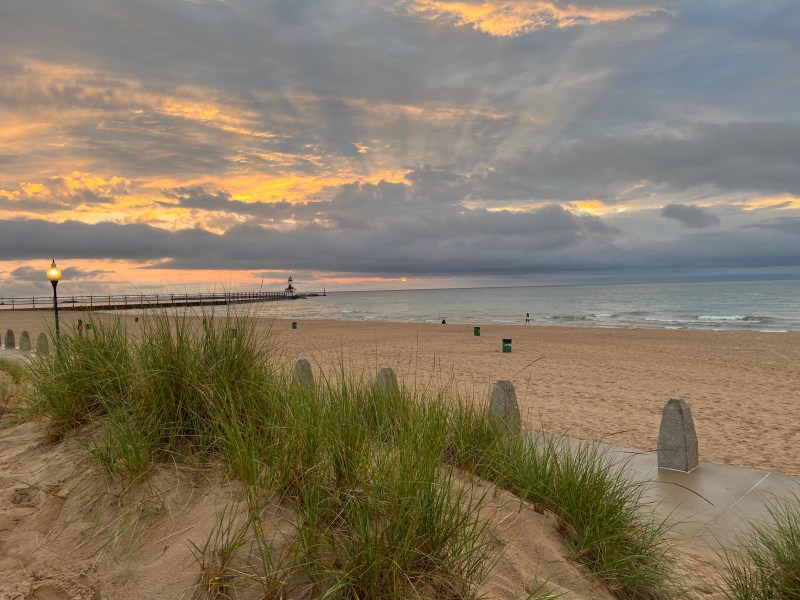
However, the sandy soil makes for miles of beautiful beaches and cliffs. Sleeping Bear Dunes National Lakeshore is one example. Its cliffs tower 450 feet above the lake. The beaches, fishing, and inland lakes make Michigan a summer’s dream.

 Moon Dance IV
WOW! So interesting to hear the geological history!!
LikeLike