I would be remiss if I didn’t include some information on the Tennessee Valley Project. It was initiated by Teddy Roosevelt during the Great Depression.
The stated purpose of the project was to improve navigability on the Tennessee River, provide for flood control, plan reforestation and the improvement of marginal farm lands, assist in industrial and agricultural development, and aid the national defense in the creation of government nitrate and phosphorus manufacturing facilities. Whew!
The Tennessee River ran through seven states, in some of the most disadvantaged areas of the South. Perhaps the boldest authority given to Tennessee Valley Authority can be found in Section 23 of the Tennessee Valley Authority Act, where TVA was given a mandate to improve ” the economic and social well-being of the people living in said river basin.”
The primary activities involved damming the Tennessee River in multiple locations and building hydro generation stations. Roosevelt felt very strongly that electricity should be a public utility and affordable. Private utility companies controlled almost all of the power in the US and charged rates that Roosevelt felt impeded development. Not surprisingly, the private companies fought the project, bring multiple lawsuits before the courts.
In the 1960s the Cumberland River was also dammed in multiple locations forming Barkley Lake and controlling the Cumberland River.
The Tennessee and Cumberland rivers flow very close to each other in the northwestern corner of Tennessee and Western Kentucky, separated by a narrow and mostly low ridge. The area of land that separates the two bodies of water has been known as “Between the Rivers” since the 1830s or 1840s.
A short canal was dug across the height of land to join Kentucky Lake and Barkley Lake; creating a massive recreational area. The Land Between the Lakes is undeveloped. It is a feast for the outdoors enthusiast, with lots to do and see in addition to fishing. There are 444 miles of scenic backcountry roadways, abundant wildlife, hiking and mountain biking trails, a planetarium, five environmental education facilities and areas set aside for horseback riding and ORVs. It was designated as an UNESCO nature preserve until President Trump removed it from the program during his tenure in the White House.

The eastern shore of Lake Barkley has a few marinas and resorts on lots rented from the TVA. Usually the marinas are adjacent to a state or federal park. There are a few small villages and towns. The lake size varies between 45-54,000 acres depending on the pool depth. The western shoreline of Kentucky Lake, opposite the Land Between the Lakes is much more developed with houses and cottages, as well as, state parks and marinas.
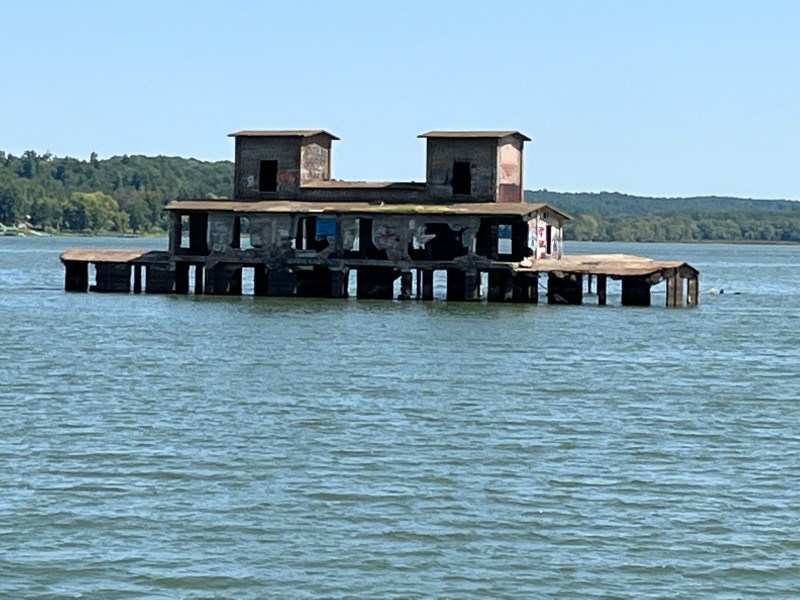
Navigation here is a challenge. In anticipation of the flooding once the lakes were impounded, buildings were demolished and forests cut where the navigation channels were planned. However, much of the forests were drowned, some without cutting the standing timber or removing the stumps. Building were razed but their foundations left standing. Except this grain elevator that refused to be blown up – or blown down whichever is the correct terminology.
Even sticking to the channel doesn’t necessarily keep your props safe as deadheads can appear with fluctuating levels and passage of tows. The pool depth also varies with power demand and seasonally so routes that were safe yesterday afternoon may not be today. It is somewhat disconcerting to look at the chart for the spot you to anchor and see a submerged road and bridge.

Historically, the TVA has been documented as a success in its efforts to modernize the Tennessee Valley and help recruit new employment opportunities to the region. Despite its successes, historians have criticized its use of eminent domain; which resulted in the displacement of over 125,000 Tennessee Valley residents and destruction of villages.
Our friend Alison relates stories of her family’s farm being expropriated by the Canadian Federal government in the 60s to form the Greenbelt that surrounds Ottawa. The emotions Alison describes are similar to those expressed in a book I just read, Drowned Town.
Drowned Town explores the multigenerational impact caused by the loss of home and illuminates the joys and sorrows of a group of people bound together by western Kentucky’s Land Between the Lakes and the lakes that lie on either side of it: Kentucky Lake and Barkley Lake.

 Moon Dance IV