Intelligence can be defined as the ability to acquire and apply knowledge and skills. I have finally put all of the pieces together and expanded my boating skills.
First of all we need to backtrack to the six weeks we spent on Lake Michigan. The first several weeks presented challenges when we were docking. Not getting the boat into the slip. John is a master at that. But tying the boat to the dock confounded us.
All of the docks where we stopped were the same design; finger piers with 6×6 pilings bolted to the outside of the fingers and extending up six feet or so. These pseudo pilings were spaced between 4 to 6 feet apart. Figuring out how to tie up Moon Dance whose cleats are ten feet apart could take up to an hour. We wanted the boat securely tied to the dock so the lines touched few surfaces. This minimizes chaff and squeaks as the boat moves with wind and waves.
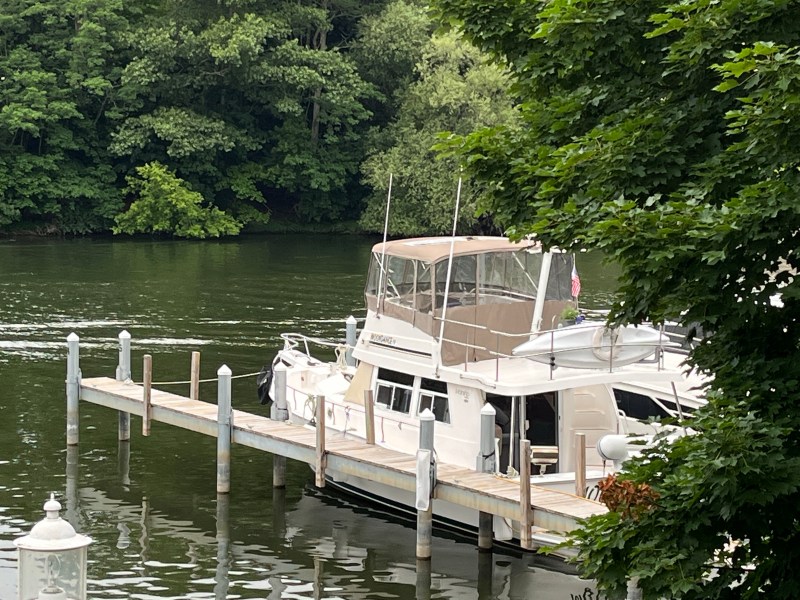
And yes, even in the harbours of refuge the waves in Michigan marinas can be considerable as west winds tend to blow straight in the channel. Not the huge waves seen out on the lake but still big enough to jostle the boat considerably. During one storm we had ten different lines on the boat; cross-tying it between two slips. We had all our chaff gear out and shock absorbers on two. Even with all that gear, several of our lines were worn flat on one side from rubbing against the piling.
We eventually learned to wrap the lines around the pilings more than once. The friction between the rope and the piling is increased and will often stop the line from sawing back and forth. The other thing we learned was to look for a marina further in the river, preferably around several bends in the channel. The municipal marinas located in the town centre on old industrial lands are interesting and close to restaurants and stores. But there is reason why all the local boaters are further inland.
These skills were filed away when we moved off Lake Michigan and started down the inland rivers south of Chicago. There are currents in the rivers but wind blown waves are rarely an issue. Locks were the focus of the daily challenge. They are sized for commercial traffic and the lifts are significant. However, that being said they are easier to navigate than the historic canals in Canada as they have floating bollards to pass a line around. The bollards are inset into the lock wall and float. They rise and fall with the water level in the lock.
I followed my usual practice when arriving at the lock. Fenders out on both sides, lines ready to be deployed on either side and a boat hook strategically placed. Imitating fellow boaters, I passed a line around the bollard and tied it off to the mid-ship cleat. Then it was simply a matter of watching to make sure the bollard didn’t get caught up. If it did I was ready to either quickly untie or cut the line. This worked fine on the Illinois River as the lifts were generally under 20 feet. The Upper Mississippi locks tend to have larger lifts and I adopted the practice of using the boat hook to fend off as the boat tended to pivot back and forth as the water level dropped.
On the Tennessee River things got a little more complicated. For one thing, we were upbound when locking is typically harder. The water floods into the chamber causing more turbulence and more movement of the boat. The lifts were enormous, many 60 feet or better. Fending off with a boat hook was just too hard. I started to rethink the process after the boat hook slipped one day and I toppled into the walk around. Other than my pride there was no damage, but obviously something better was required.
I not sure when the revelation occurred. Perhaps during a late night solitaire game or when flipping open one of my chart books, I quickly flipped back to the introduction the Corps of Engineers includes in all of their books. Yes there is was “… pass a line twice around the floating bollard to stabilize the boat and eliminate swing.” The pieces fell together.
Double wrapping a piling in Lake Michigan or a bollard on the Tennessee accomplishes the same thing – less work and a more comfortable ride.
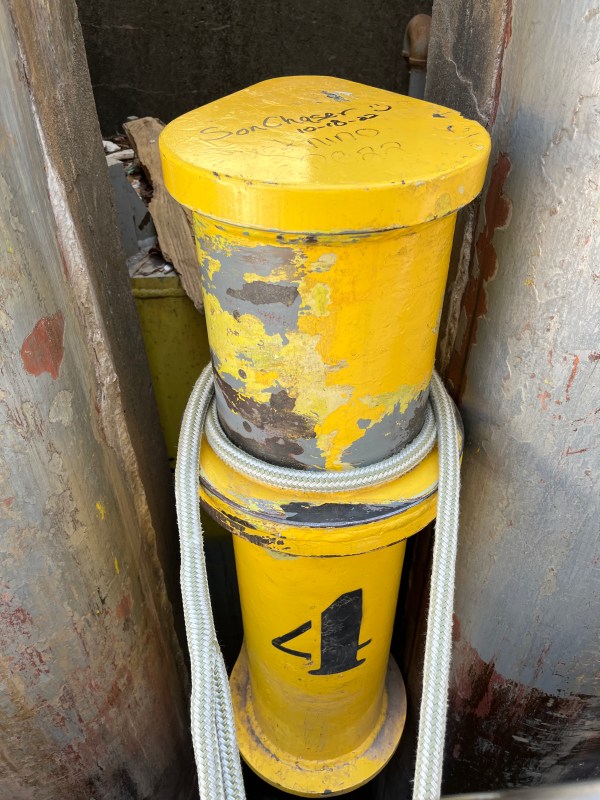
Floating bollard

 Moon Dance IV