The Intracoastal Waterway (ICW) is a 3,000-mile (4,800 km) inland waterway along the Atlantic and Gulf of Mexico coasts of the United States. The Atlantic intracoastal waterway (AICW) extends from Key West, Florida, north to Portsmouth, Virginia (milepost 0.0).
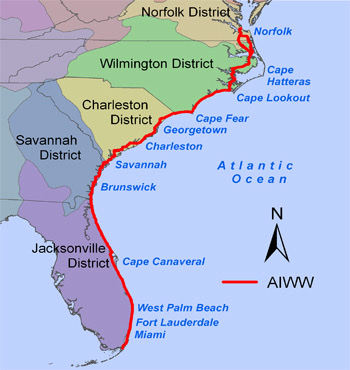
Some sections of the waterway consist of natural inlets, saltwater rivers, bays, and sounds, while others are artificial canals. It provides a navigable route along its length without many of the hazards of travel on the open sea.
The central and southern Atlantic Coast is characterized by barrier islands and drowned valley coasts. The coastal plain features nearly continuous barriers interrupted by inlets, large embayments with drowned river valleys, and extensive wetlands and marshes. The relief at the land-sea interface is so low that the boundary between them is often blurry and indistinct.
Each state promotes their shoreline with nomenclature that differentiates its coast from other states, but the geography is all the same. The vegetation changes somewhat as you head north or south. Saltwater and marshlands thick with cordgrass; live oaks and Spanish moss in the south give way to mixed hardwood further north.
Posts from the AICW:
Florida – First Coast, Space Coast, Treasure Coast, Gold Coast
- Heading For Home
- Catching Up with a Gang
- A Relaxing Day
- St. Patty’s Day
- A Short Stay at Eau Gaille
- Flipper? Is That You?
- St. Augustine
- Tidbit: Tiki Huts
- Florida
Georgia – The Golden Isles
South Carolina – The Low Country
North Carolina – The Outer Banks
- Southport, NC
- Loopers are like Lemmings
- Life Happens
- Swansboro, NC
- Open Water
- Middle of Nowhere
- Trifecta
Virginia
 Moon Dance IV