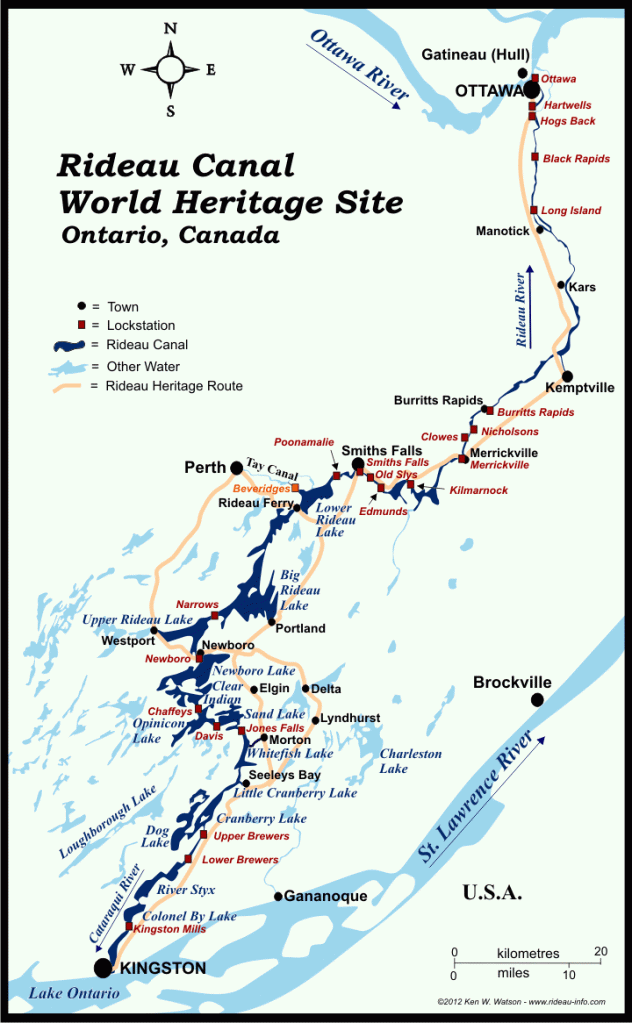
The Rideau Canal, a monumental early 19th-century construction covering 202 km of the Rideau and Cataraqui rivers from Ottawa south to Kingston Harbour on Lake Ontario. It was built primarily for strategic military purposes at a time when Great Britain and the United States vied for control of the region. One of the first canals to be designed specifically for steam-powered vessels, it also features an ensemble of fortifications along the route. It is the best-preserved example of a slackwater canal in North America, demonstrating the use of this European technology on a large scale. It is the only canal dating from the great North American canal-building era of the early 19th century to remain operational along its original line with most of its structures intact.
In 1821, the river was surveyed by the civil engineer Samuel Clowes, who decided that the Rideau River could be turned into a useful trade route for the absurdly low cost of £62,258. British politicians weren’t keen on building a canal along the Rideau River. As far as they were concerned, relations with the US had cooled since the war, and the project of building a canal in Canada didn’t seem worth the trouble.
However, the low estimate, as well as the advice of several key figures, finally won the project a green light and in 1826 Lieutenant Colonel John By was hired to design the Rideau Canal.
Building the Rideau Canal
The construction of the Rideau Canal started in 1827 and lasted until 1832. Thousands of Irish and French Canadian carpenters, stone masons, and other labourers were hired to work on the canal, but construction was difficult for several reasons.
First, the canal ran through what was then mostly untamed swampland. Houses for labourers had to be built, and huge swaths of land cleared before construction could take place. All work being done by hand – caused great hardship to its Irish labourers, many of whom died of malaria. Up to 2000 men were employed by the Royal Engineers and appointed contractors.
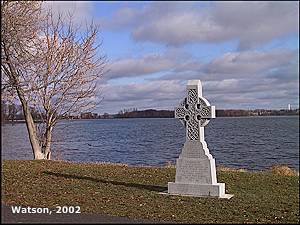
http://www.rideau-info.com/canal/history/memorials.html
On top of that, John By realized that the locks of the canal needed to be redesigned. The original concept for the locks couldn’t handle the new steamboats that were being used in Canada, and By didn’t want the canal to be outdated before it was even finished.
Problems with contractors also drove up the cost of construction, until the Rideau Canal was finally completed for £800,000. While the final cost was still reasonable for such a large undertaking, it was so far off the original estimate that By was disgraced.
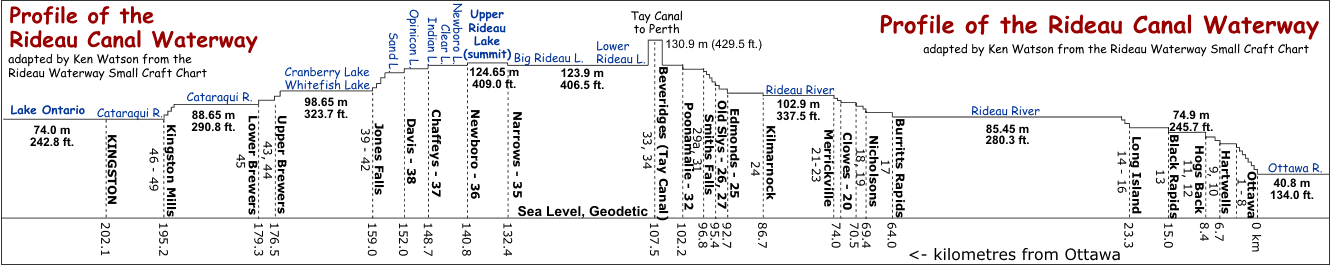
About 50 dams were necessary to control the water levels at rapids on the Rideau and Cataraqui rivers. The 46 (originally 49) locks in use raise vessels 83 m from the Ottawa River to the portage channel at Newboro, whence vessels descend 50 m to Lake Ontario at Kingston.
The construction of the Rideau Canal – built in virgin forest with the canal ranks among the greatest early civil-engineering works of North America. Lieutenant-Colonel By located his headquarters at the junction of the Ottawa and Rideau rivers and started a small settlement, first named Bytown in his honour but renamed Ottawa in 1855.”
Finkelstein, Maxwell W. and Robert F. Legget. “Rideau Canal”. The Canadian Encyclopedia, 23 January 2017, Historica Canada.
Posts from the Rideau Canal:
 Moon Dance IV